
Big-Billet Volume Evaluation: Complete 3D Geometry Capture for Heavy Long Products
-
in Techno Blog
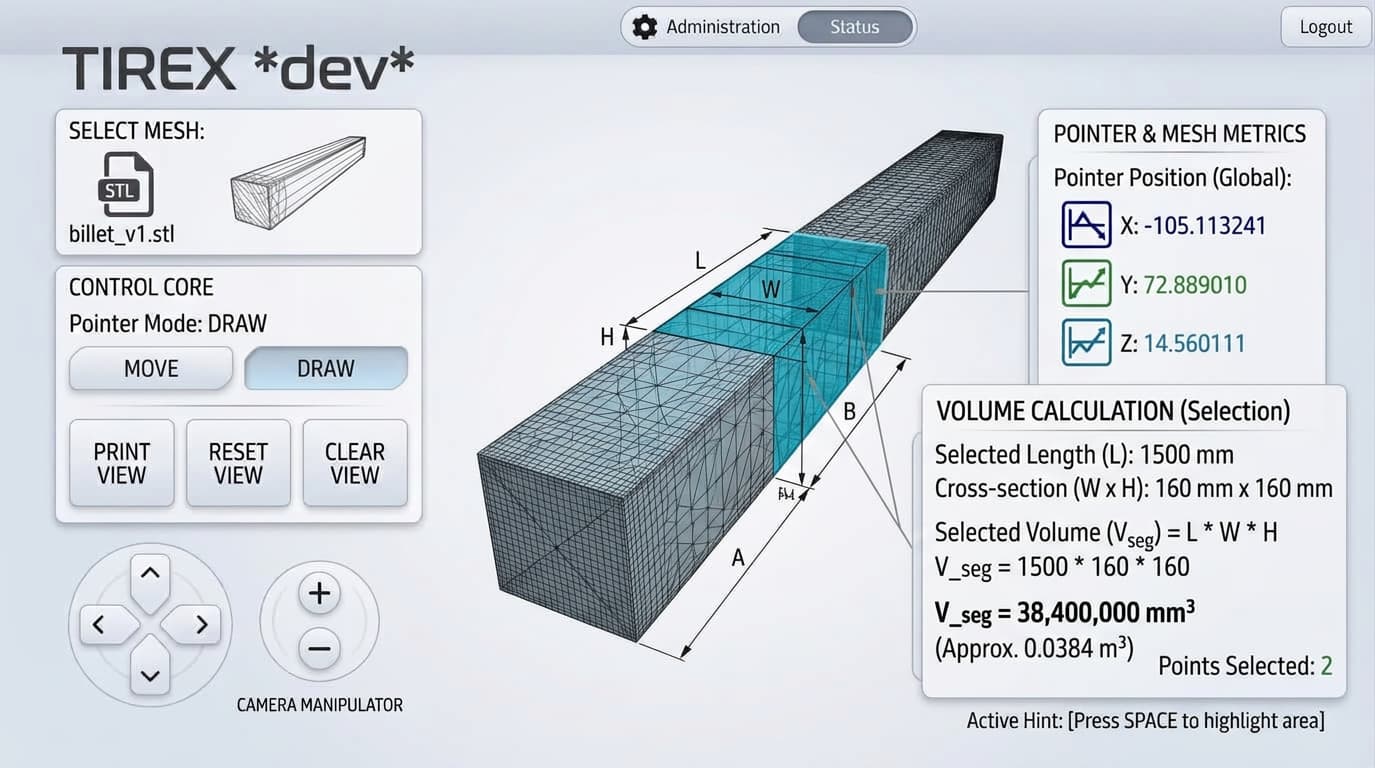
In steel and aluminium mills, knowing the exact volume of a billet as it transfers between process stages is no longer a matter of estimation. LGE Engineering's multi-sensor 3D profilometry architecture reconstructs the full geometry of large billets in motion, calculating volume, cross-sectional areas, and convexity deviations on surfaces that are often hot, reflective, and geometrically irregular.
The challenge with big-billet volume evaluation has never been the mathematics of integration. It is the data acquisition problem. A billet leaving a continuous caster or reheating furnace is not a perfect prism. It may exhibit bulging, corner rounding, taper, or localized surface irregularities that simple width-and-thickness measurements cannot capture. Traditional point gauges—calipers, single-axis lasers, or contact devices—sample too little of the surface to build a defensible volume figure. The result is a measurement that is technically a number but practically an approximation.
LGE's approach inverts this limitation. By deploying multiple laser profilometers around the product path, the system captures the complete circumference and length of the billet during transfer, without interrupting the process. The output is a dense 3D point cloud from which the volumetric algorithm derives exact volume, cross-sectional area at any position along the length, and convexity deviations that reveal shape irregularities invisible to single-axis measurement.
Architecture and Sensor Performance
The core platform for this capability is LGE's 3D Shaper series, a multi-sensor laser profiling architecture designed for complete 3D characterization of long products. Three to six laser profilers are arranged around the product to capture full circumferential geometry, with scan rates reaching 100 profiles per second . Each profile can contain up to 3,200 points, with Z-axis resolution in the micrometre range depending on the model selected . The sensor heads are rated IP67 and can be configured with cooling options for operation near hot products .
For big-billet applications, the relevant frame configuration is the heavy-duty end of the 3D Shaper range, which scales to accommodate large structural sections and billets . The static-sensor arrangement—lasers fixed in the frame while the product passes through the measurement field—eliminates moving parts in the harsh mill environment, a design choice that favours reliability over mechanical complexity.
The system communicates via GigE Vision, Ethernet/IP, or PROFINET, allowing direct integration with PLC and MES infrastructure . This matters for volume evaluation because the measurement is only useful if it feeds downstream decisions: cut optimisation, yield reconciliation, or process adjustment.
From Point Cloud to Volume: The Algorithmic Layer
The volumetric algorithm is where LGE's solution distinguishes itself from conventional profile measurement. Raw 2D profiles from each sensor are stitched into a continuous 3D point cloud representing the billet's full surface. From this reconstruction, the software computes:
- Exact volume by integrating cross-sectional areas along the measured length, rather than assuming a nominal rectangular or square section.
- Cross-sectional areas at any position, enabling detection of taper, bulging, or local reduction that affects downstream rolling or forging.
- Convexity deviations that quantify how far the actual surface departs from a convex hull—a direct indicator of shape quality and a parameter that correlates with cracking risk during subsequent processing.
LGE's scanner platform explicitly lists volume measurement as a standard analytical output alongside dimensional extraction and surface reconstruction . The same software suite provides real-time profile visualisation and measurement tool configuration, with SDK compatibility for C++, Python, .NET, and ROS, allowing mills to embed volume data into proprietary process models .
The Hot and Reflective Surface Problem
Big billets are frequently measured at temperatures where contact is impossible and where thermal radiation confounds conventional optical sensors. The problem is compounded by the reflective character of freshly cast or scarfed steel and aluminium surfaces, which can saturate or scatter laser light unpredictably.
LGE's portfolio addresses this through sensor selection rather than a single-technology claim. The company notes the industry's move from X-ray to confocal technology for applications requiring extreme precision on reflective or complex surfaces . Its 3D Shaper systems are deployed in hot rolling and continuous casting environments where non-contact measurement is essential . The multi-sensor architecture itself provides a degree of redundancy: a single sensor losing signal to a specular reflection or scale patch does not invalidate the reconstruction, because overlapping coverage from adjacent profilers fills the gap.
It is worth being precise about what the search results confirm and what they do not. LGE's public documentation confirms billet dimension, temperature, and surface measurement as an application area , and confirms volume measurement as a software output of the 3DShaper platform . The specific claim of a dedicated "big-billet volume evaluation" product line with published accuracy figures for hot, reflective billets is not substantiated in the available public material. What the documentation supports is the existence of the enabling architecture—multi-sensor 3D profiling, volume algorithms, hot-environment deployment—from which such an application is configured.
Why Volume Matters Beyond Dimensional Compliance
For mills, billet volume is not an academic parameter. It is a yield accounting input. If a billet's true volume differs from the nominal volume used to set rolling schedules or cutting plans, the discrepancy propagates through the entire downstream process. A billet that is heavier at one end, or that bulges asymmetrically, will produce a coil or bar with unexpected mass distribution, potentially forcing conservative cuts that reduce yield.
Convexity deviation adds a quality dimension that diameter or diagonal measurements miss. A billet with acceptable nominal dimensions but poor convexity—say, a concave face or excessive corner rounding—may pass a simple gauge check yet behave poorly in the first rolling stand. Capturing this parameter inline, on every billet, transforms it from a post-mortem explanation for a cobble into a preventive signal.
Integration and the Closed-Loop Trajectory
LGE's broader philosophy is that measurement should not terminate in a report. The 3D Shaper platform supports closed-loop feedback to sizing stands, straighteners, and cut-off saws, enabling automatic correction rather than manual intervention . For billet volume evaluation, the logical extension is clear: volume and convexity data feeding cut optimisation or caster withdrawal speed adjustment, closing the loop between what the billet actually is and what the next process stage assumes it to be.
The practical value of LGE's big-billet volume evaluation lies less in any single specification than in the integration of three capabilities that are typically purchased separately: full-surface 3D capture, volumetric computation, and mill-hardened deployment. For mills where yield reconciliation and first-stand reliability are measurable in currency rather than percentages, that combination is the proposition.